What is AI actually good at in marketing?
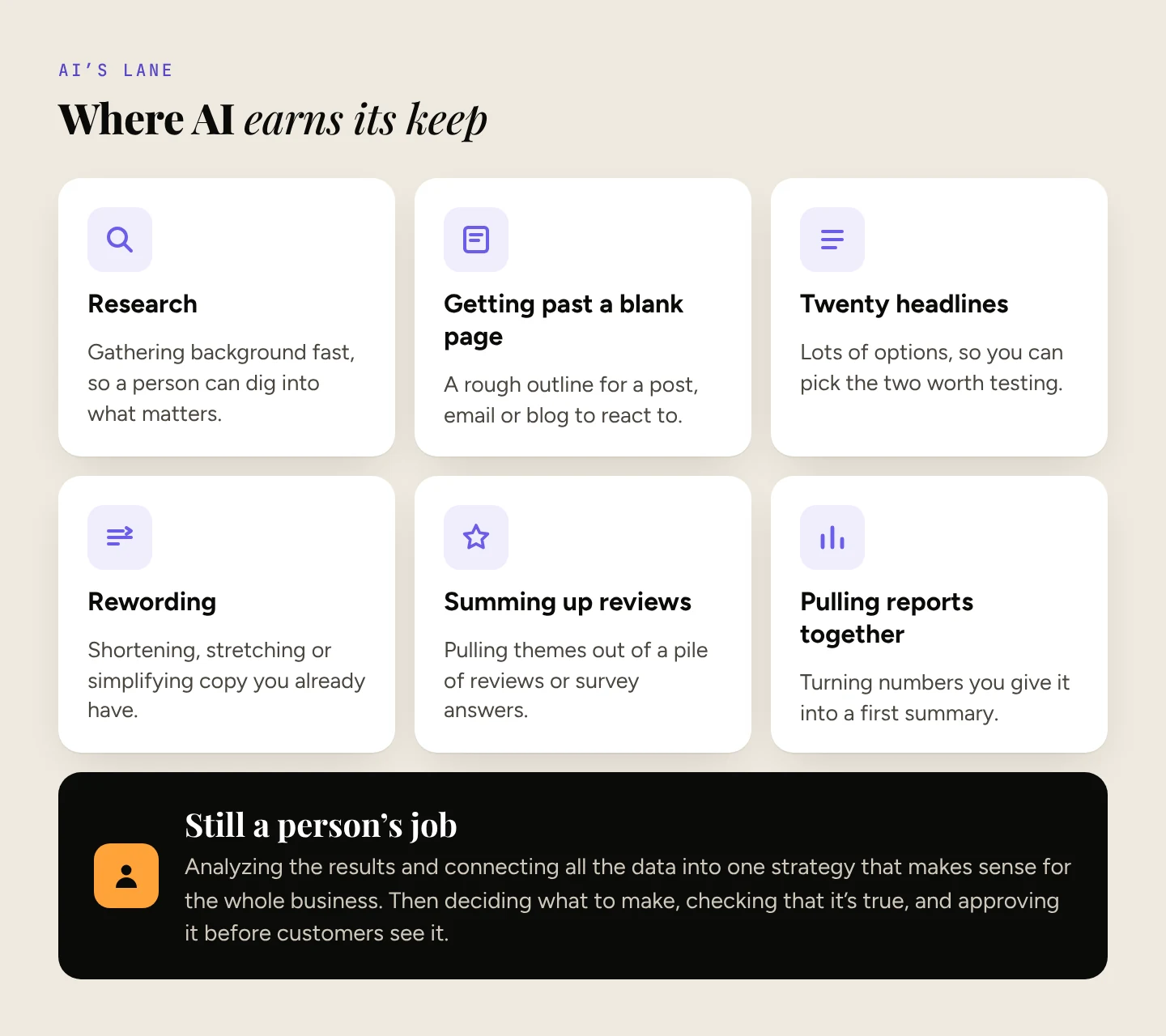
Quite a lot, honestly. I'd be lying if I said otherwise. We use it to brainstorm, draft, research and handle routine tasks like reporting, and it saves us real hours every week. The skill is in directing it well and knowing what to keep.
Where it tends to earn its keep:
- Getting past a blank page on a post, email or blog outline
- Coming up with twenty headlines so you can pick the two worth testing
- Shortening, stretching or simplifying copy you already have
- Summarizing a pile of reviews or survey answers
- Giving you a nudge when you're stuck
So this isn't an anti-AI article. Cameras didn't replace photographers. They changed what photographers spend their time on. The better question is who decides what the AI makes, and who checks it before your customers see it.
Where does AI fall short on its own?
I'd put it down to five gaps. You won't notice any of them by reading one nicely written paragraph. They tend to show up later, in your phone calls and your ad spend.
-
It doesn't know your business
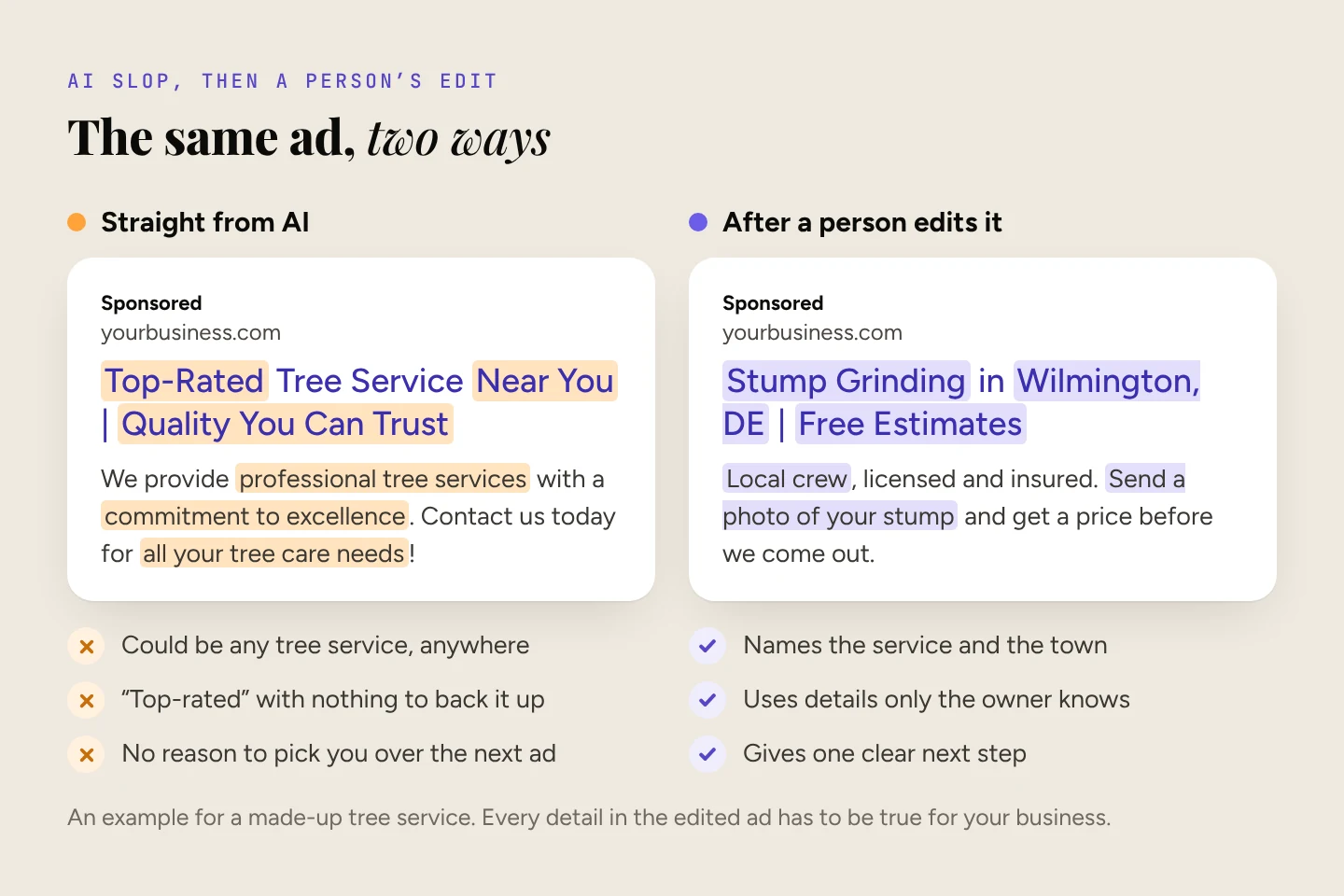
AI learns from what's already out there. Ask it for a landscaper's homepage and you'll get something that sounds like every landscaper's homepage. That's exactly the problem. Someone comparing three companies needs a reason to call yours.
The things that make copy work live in your head and your inbox: why your best customers picked you, what you charge and why, the questions people ask on the first call. That's where we start, and no prompt can pull it out of thin air.
-
Sometimes it's wrong, and sure of itself
Now and then AI makes things up, and it sounds just as sure of itself when it does. Google says as much in its own guidance for site owners: check every AI-written thing by hand before it goes live, right down to page titles and the code behind them.
On a business site, that might be a service you stopped offering, last year's prices, or a statistic nobody can trace. Small stuff, but it's the kind of thing that makes a customer quietly close the tab.
-
It makes pieces, not a plan
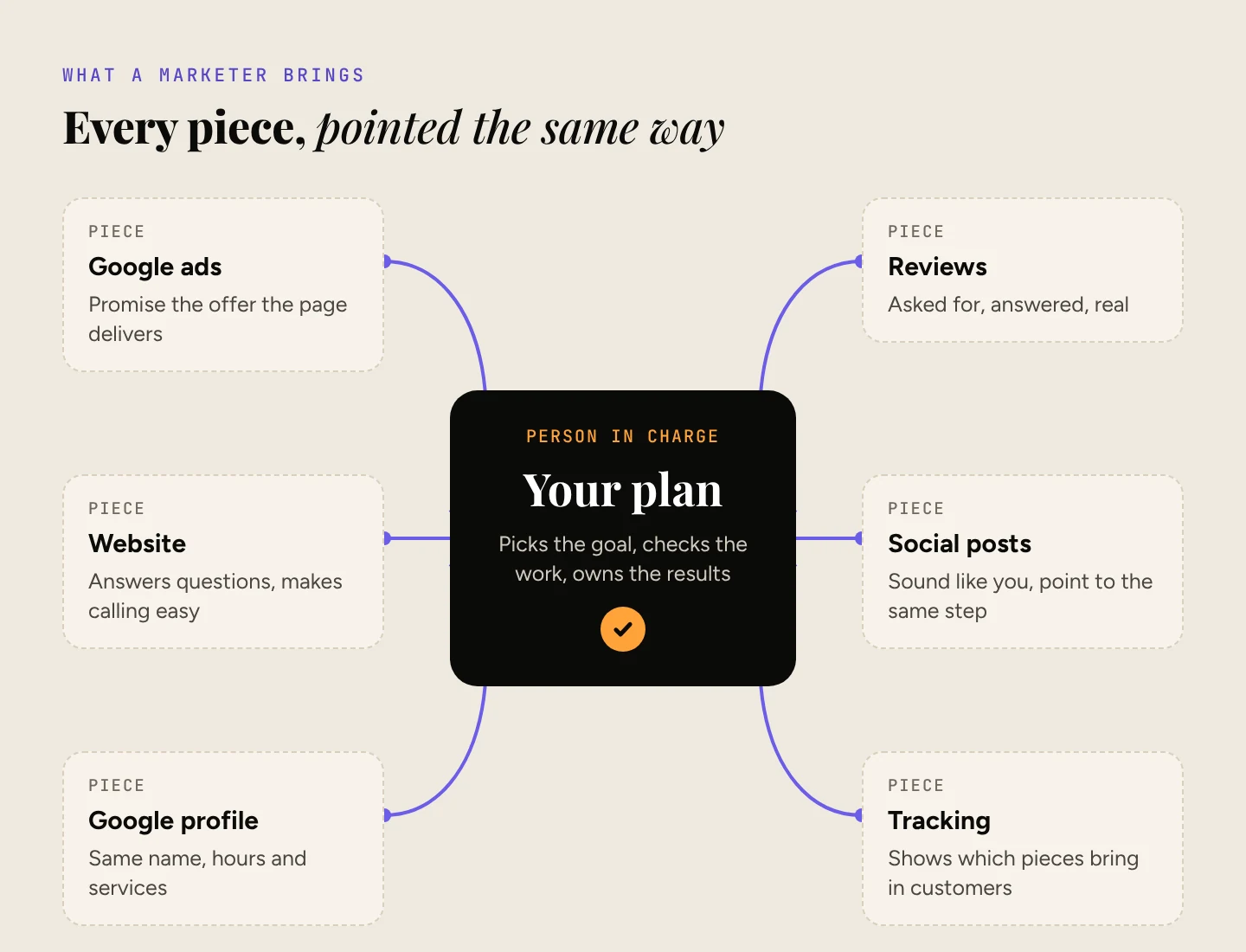
Ask for an ad and you'll get an ad. Ask for a landing page and you'll get one of those, too. They just won't have anything to do with each other unless somebody makes them fit. It happens more than you'd think: the ad promises one offer, the page talks about another, and there's no tracking, so nobody can say what worked.
Marketing works when it's connected. Your Google profile, website, ads, reviews and follow-up should all walk the same customer toward the same next step. Figuring out how that fits together is the actual job.
-
Nobody answers for it but you
When AI gets something wrong, the tool doesn't pay for it. You do. Two examples worth knowing about:
- Search: Google treats a flood of pages that don't really help anyone as spam, and says so plainly. Fifty AI pages pushed out to rank faster can do the opposite.
- Reviews: Fake reviews have been against FTC rules since fall 2024, and that covers glowing testimonials from people who were never customers, or never existed. Reviews written by AI were a big reason for the rule, and the FTC can fine businesses that break it.
-
It doesn't know your town
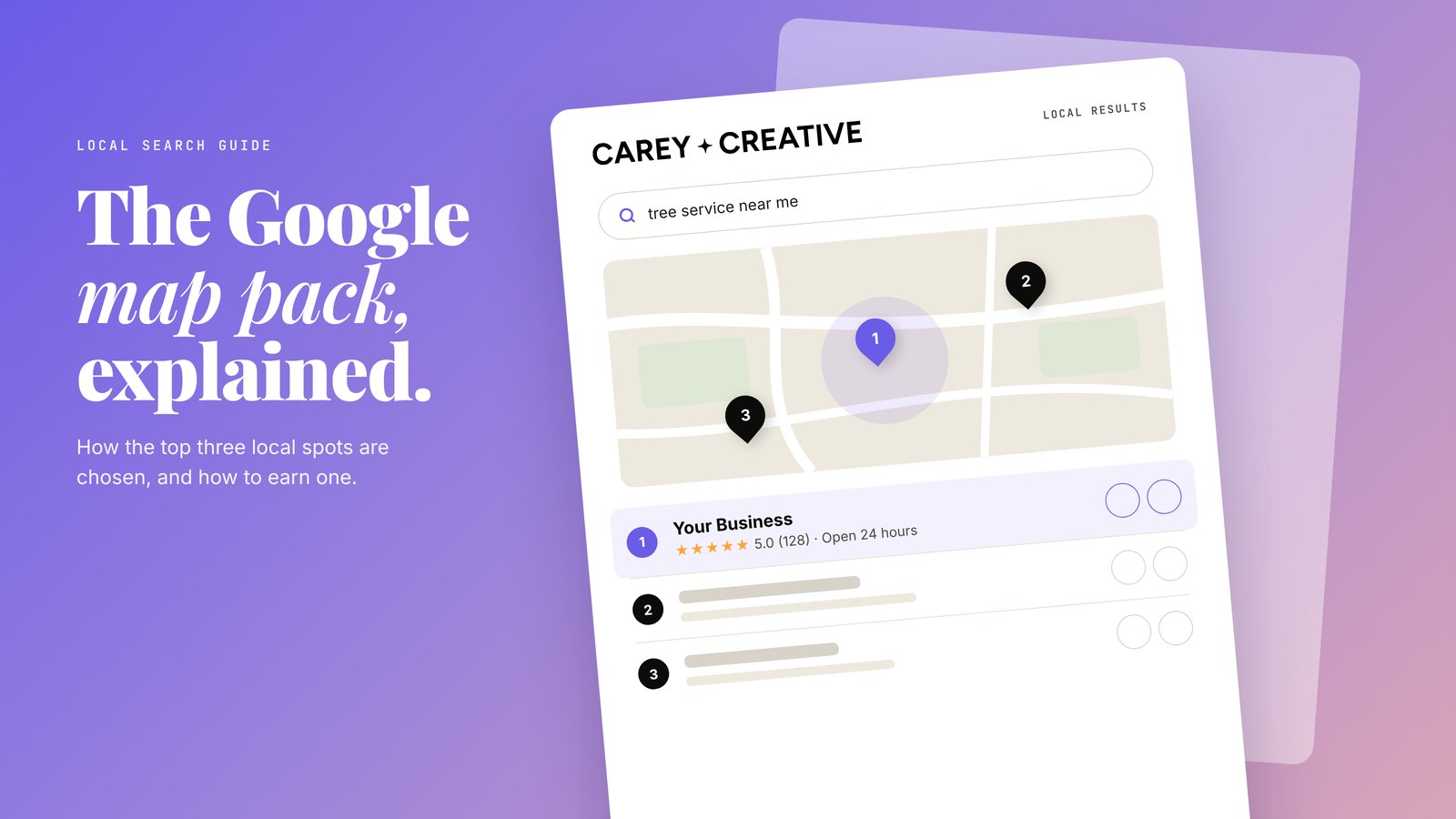
AI has no idea a competitor down the road just started running ads, or that your phones pick up in April, or that most of your calls come straight from Google Maps. Someone paying attention does. For a local business, even holding a spot in the Google map pack takes regular, hands-on care.
What does a marketing professional bring that ChatGPT can't?
Put simply, a person sets the direction, checks the work and answers for the results. Here's roughly how it splits:
| The job | What the tools handle | What a marketer does |
|---|---|---|
| Strategy | Suggest ideas that could fit anyone | Picks goals, customers and channels that fit your budget |
| Messaging | Draft copy in seconds | Finds what makes you different and says it plainly |
| Accuracy | Sound convincing | Checks facts, offers and claims before anything goes live |
| Connection | Make one piece at a time | Gets your site, ads, profile and reviews working together |
| Measurement | Summarize numbers you give it | Sets up tracking, reads it and decides what to change |
| Accountability | Nothing | Owns the results and fixes what isn't working |
In practice, the best setup is usually both: a person who knows marketing, using AI wherever it actually saves time.
Can a small business get by on AI alone?
For a while, maybe. If you're just getting started, money is tight and you only need a couple of posts a week, a chatbot and some common sense will get you pretty far. I'd tell a friend the same thing.
It gets riskier once real money is on the line. When you're paying for ads, or your website is where most of your leads come from, a mistake can cost more than the help would have.
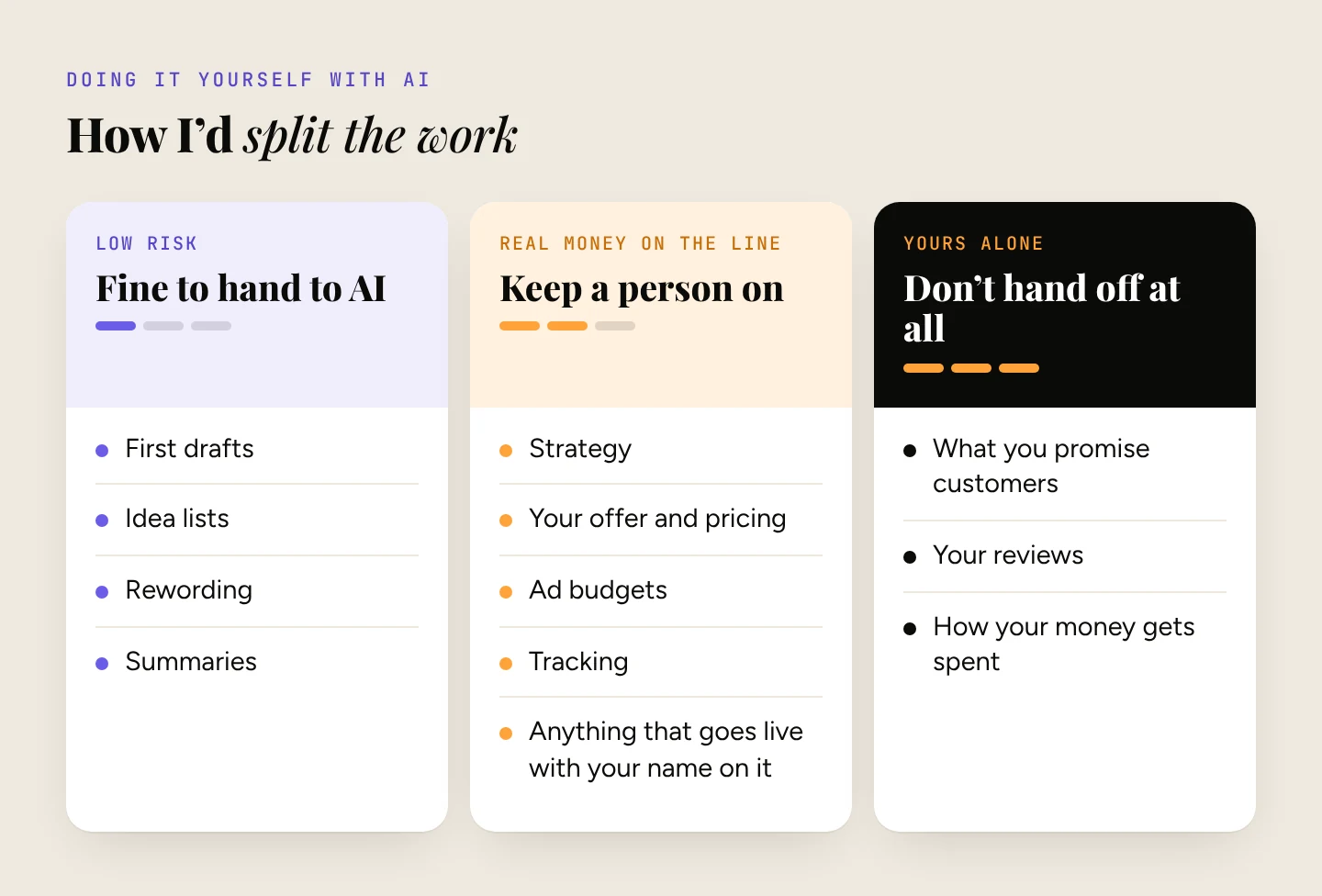
If you're going the DIY route, here's how I'd split it:
- Fine to hand to AI: first drafts, idea lists, rewording, summaries
- Keep a person on: strategy, your offer and pricing, ad budgets, tracking, and anything that goes live with your name on it
- Don't hand off at all: what you promise customers, your reviews, and how your money gets spent
How do you know if you need a marketer?
Be honest with yourself on these. If two or more sound familiar, it's probably time to get some help.
What should you look for in a marketer in the age of AI?
Not someone who refuses to touch AI. That's not much of a selling point anymore. You want someone who uses it where it helps and keeps a real person on the decisions. A few questions worth asking on the first call:
- How do you use AI, and who checks the work before it goes live?
- How will we know if this is working?
- Can I see work for a business like mine?
- Who will I actually be talking to each month?
- Can I ask you not to use AI on my account?
If the answers get vague, keep looking.
Where to start
If you're stuck between doing it yourself with AI and bringing in help, a few places to start:
- Request a free website audit. Someone on our team reviews your site and local presence by hand.
- See how we plan where to focus, build websites with SEO foundations and run Google ads.
- Read up on the Google map pack and how local businesses earn a spot.
Or just book a discovery call. We'll tell you honestly what you can handle with AI on your own and where a person would make the bigger difference.
Frequently asked questions
Will AI replace marketing agencies?
It'll take over some of the work agencies used to bill for, like basic first drafts. It's much less likely to replace strategy, judgment and someone who answers for the results. The agencies most at risk are the ones that only ever sold volume.
Is AI-generated content bad for SEO?
Not on its own. Google cares about accuracy, quality and relevance, and it asks site owners to fact-check and review AI content by hand. Where people get in trouble is mass-producing pages that don't add anything.
Can ChatGPT run my marketing?
It can help with parts of it, like drafts and ideas. It can't set your budget, run your ad account, follow up on leads or decide what to change next month. Somebody still has to.
Is it cheaper to use AI than to hire a marketer?
The tools are cheaper up front. But wasted ad spend, a site that doesn't turn visitors into calls, or content that drags your rankings down can cost more than the help would have. Look at what each option brings in, not just what it costs.
Does Carey Creative use AI?
Yes, as a tool, not a replacement. We use it to brainstorm, draft, research and handle routine tasks like reporting. We know how to direct it, and a person on our team refines every result, takes it further and approves everything before it goes live, so no AI slop or hallucinations reach your customers. If you'd rather we not use AI on your account, just say so.
What's the difference between AI marketing tools and a marketing agency?
AI tools make content when you ask for it. An agency decides what to make, why and who it's for, then ties it together and tracks what happens. See the full comparison →
Sources
Claims about Google and the FTC come from these pages: